

When Cyber security Pros Turn Predator & New Hidden Malware Threats: Lessons for 2026
1. A Shocking Betrayal: Cyber security Experts Plead Guilty in Ransom ware Conspiracy
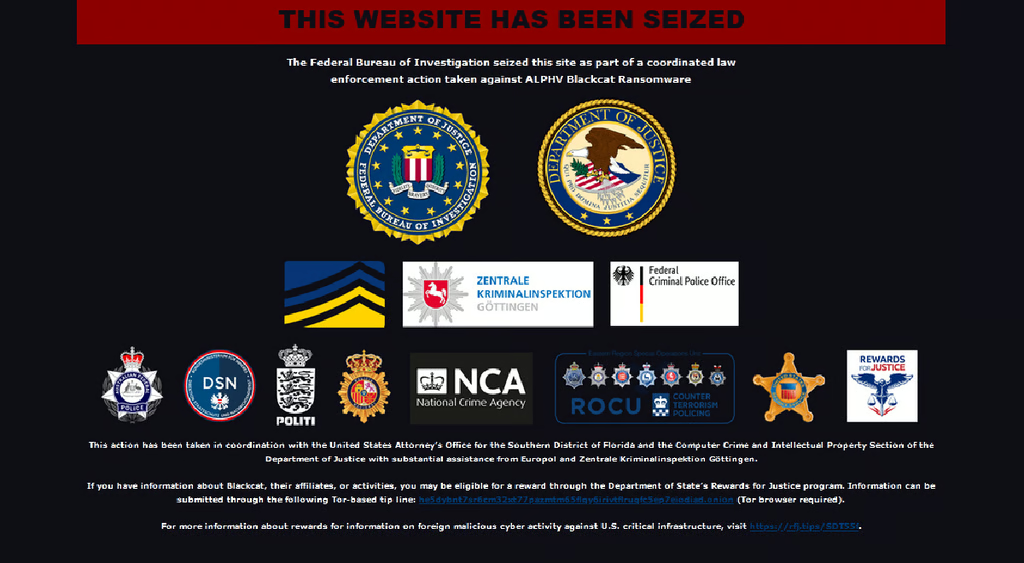
In an unexpected turn of events that has shaken the cybersecurity world, two veteran U.S. cybersecurity experts have pleaded guilty to conspiring with the ransomware gang ALPHV/BlackCat to extort American companies. According to federal prosecutors, Georgia resident Ryan Goldberg and Texas resident Kevin Martin pleaded in a Miami federal court to conspiracy to interfere with commerce through extortion. Both are facing up to 20 years in prison each at their sentencing scheduled for March 2026.
What seals the notoriety of this case is not only the egregiousness of the crime but also that the perpetrators were former employees in defensive security roles: one as an incident response manager and the other as a ransomware negotiator, positions normally entrusted with protecting organizations from exactly this sort of threat.
2. Misused Expertise: How Security Knowledge Became a Weapon
What is particularly disturbing about this case, however, is the improper use of expert knowledge of cyber security. Rather than protecting computer systems, the accused purportedly utilized this knowledge for the installation of ransom ware, encrypting victims’ information, and extorting $100 million in ransoms through cryptocurrency. They worked alongside another conspirator, whose name has not been revealed, and employed insider knowledge of how to respond to an incidence to remain undetected for a longer period of time compared to normal criminals.
A known victim, a medical device company, reportedly paid more than $1.2 million in Bitcoin to restore their system usage. The high degree of trust given to these individuals makes one thing abundantly clear: technical acumen does not guarantee honesty or fidelity to the organization. Cyber security recruitment practices cannot dismiss such a fact. (Cybernews)
3. Why This Matters: Insider Threats Complicated
Though insider threats have existed for some time, the transition of security professionals from protectors to adversaries has introduced a significantly greater degree of risk than that posed by traditional insider’s. While traditional insiders generally expose or accidentally expose systems due to careless behaviour, today, insiders actively use their skill set as a weapon against their employer. As a result, corporations must review their threat model to include an additional category of threat that addresses the possibility that a trusted employee with legitimate access will use that access against the organisation. (Cybernews) The traditional approach to the development and implementation of cyber security strategies has placed an overwhelming emphasis on perimeter-based security, such as firewalls, encryption, access tokens, patching, etc. As demonstrated in this situation, it is important that human factors and trust relationships as part of the overall defensive strategy experiencing security incidents that will affect organisations that deal with sensitive or critical assets.
4. The Rise of Kernel-Level Malware: ToneShell Backdoor Identified
Though insider attacks make headlines with regard to the shocking nature of such attacks, a pattern of a similar nature is emerging within the external landscape. A new variant of the ToneShell backdoor has been discovered by researchers which is attributed to the government-aligned Mustang Panda (also known as HoneyMyte) group. (TechRadar)
The backdoor malware is distributed in an intelligent and hidden manner through a kernel-mode driver. One of the reasons why the malware is highly destructive is the fact that it resides deep inside the Windows OS. Hence, it is difficult to be detected by security mechanisms that are limitations to user-mode malware and lack the ability to monitor kernel-mode. (TechRadar)
5. Anatomy of a Stealth Malware: How ToneShell Operates
The recently found ToneShell backdoor variant has various important attributes:
- Kernel-mode access: This is made available by a malicious driver signed with the intention of intercepting the kernel-mode functions. (TechRadar)
- Rootkit behaviours: The malware is able to hide files, processes, and registry entries by integrating itself into the operating system. (Cybernews)
- Remote control: After infiltration occurs, it’s possible to upload/download files as well as perform remote command execution, along with persistence in the attacked computing system. (TechRadar)
The use of stolen or leaked code-signing certificates allows this malware to pass superficial security checks, meaning that even well-maintained environments could be vulnerable without deeper inspection mechanisms. (HawkEye)

6. Why This Threat Changes the Game
This new variant of ToneShell underlines an emerging trend in cyber espionage: malware that reaches deep into system architecture to evade detection. Unlike ransomware, which typically has a major focus on financial extortion, backdoors such as ToneShell grant hackers continuing surreptitious access to critical infrastructure-a hallmark of state-linked campaigns. (TechRadar)
And, as government agencies, defense ministries, and organizations handling sensitive political, economic, or security data, should note: these threats are engineered for longevity and stealth-not just immediate disruption. The evolution in malware sophistication is bound by the need to develop more advanced strategies for defense than ever before.
7. The Dual Lessons: Trust and Technical Vigilance
Both of these reports illustrate two points:
- Risks Within the Organization- Every trusted employee has the potential to jeopardize an organization as long as the organization does not provide defined expectations and accountability regarding his/her behavior and ethics.
- Sophisticated External Threats- Backdoors such as ToneShell provide a new type of threat that may not be detected or suppressed by conventional security measures. Organizations using only basic antivirus software or perimeter security will increasingly find themselves at risk. Organizations now clearly require adaptive, multi-layered, intelligence-driven, and vigilant security..
8. How Sprit Network Supports Organizations against these Threats
We at Sprit Network are aware of the risks posed by insider threats as well as the sophistication of malware threats that are stealthy in nature. Here is how we assist organizations to improve their overall cyber security posture:
Hands-On Risk Assessments
While most vulnerability scanning analyses patterns of breach activity, our process extends beyond typical vulnerability scan results for the assessment of insider risk indicators, behavior anomalies, and misuse of privilege access.
Advanced Threat Monitoring & Detection
Our solutions combine next-generation endpoint detection and response (EDR) with monitoring at the kernel level to provide early and precise detection of threats such as ToneShell.
Incident Response & Forensics
Should a threatening attack occur, Sprit Network has a skilled response team ready with quick actions from containment and analysis, all with the goal of lessening any possible damage and expediting a rectification process.
Human-Centric Security Training
Awareness, ethics, and threat recognition skills necessary for limiting risky behaviors and unintended vulnerability are what our services provide to teams.
Continuous Strategic Support
Through 24/7 monitoring capabilities, updates to threat intelligence, and proactive security roadmaps, the Sprit Network helps your business always stay one step ahead of both internal and external threats.
Conclusion: As cyber threats evolve in both source and sophistication, organizations must adapt with robust, intelligent, and multi-layered defenses. With expert support from Sprit Network, you can build a resilient security posture prepared for 2026 and beyond.